Rock, Classic
Hotel California
Eagles
1976
Review #001 — Reviewed 23 August 2026 — 50 YEARS late to the party.
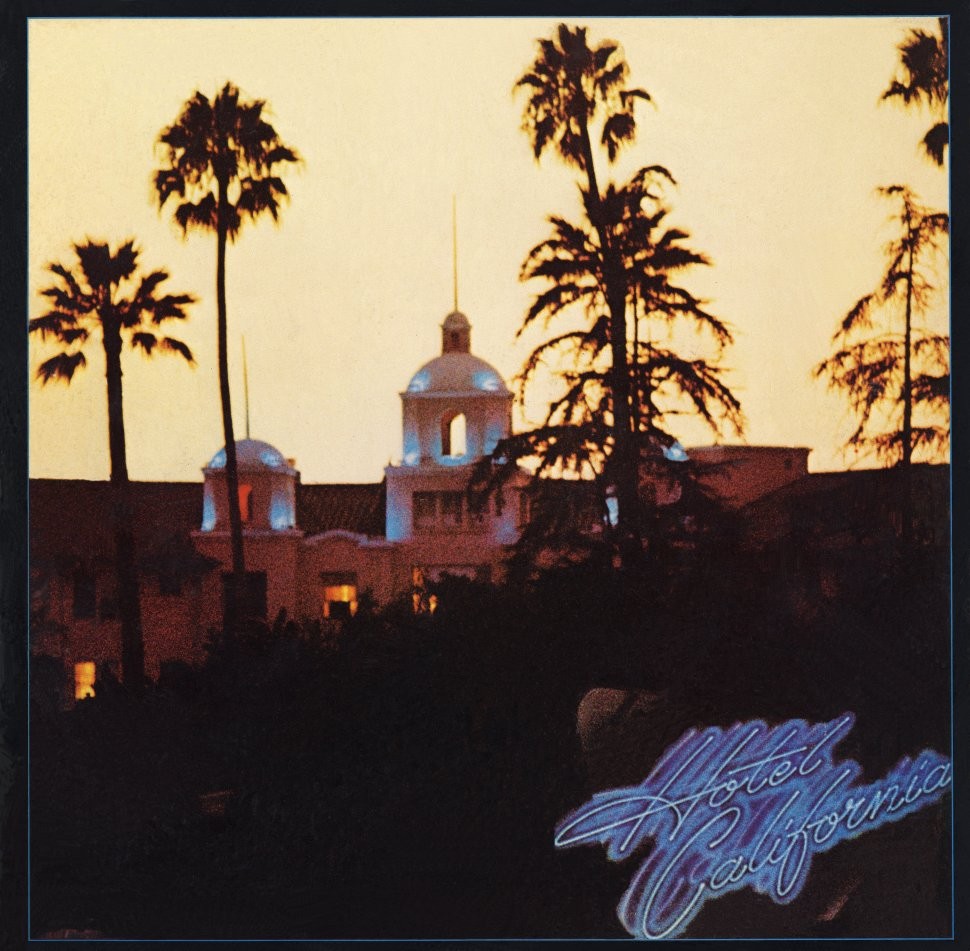
Upon stepping through the door at the Hotel California, you are greeted with 51 seconds of one of modern rock’s most recognisable guitar riffs. Anyone fortunate enough to live through the late ’70s and early ’80s is now experiencing a horrific flashback. This won’t be a cliché album review (we won’t be touring a metaphorical hotel, not even a literal one). Don Henley was once quoted by ZigZag Magazine as saying "This is a concept album, there's no way to hide it, but it's not set in the old West, the cowboy thing, you know. It's more urban this time." But is it a concept album? I mean, the answer is obviously yes, one of the guys who wrote it said it was a concept album. But not in the Old West, perhaps the New West.
The gold had changed, but the rush remained the same. California was still the destination for those looking to make something of the miserable life that had been graciously bestowed upon them. The migration west had been ongoing for about 170 years at this point, and the motivation for the move had changed from self-preservation to self-indulgence. As we all know, when settlers moved west of the Appalachians, they too were in search of fame, wealth, casual sex and an abundance of nose beers, or nosés if you will. As the ’70s drew to an end, the motivation had shrunk to simply the improvement of onanism. At the time, Los Angeles was the epicentre of the entertainment industry. It was the logical destination for those looking to pan for fame, sex and cocaine. A multibillion-dollar record industry had those blessed with an ability to play an instrument (preferably a cool one. No cellos.) migrating west. The market for physicists and astronauts had become oversaturated in the post-Space Race era. Becoming a musician was the only sane thing left to do.
The gold had changed, but the rush remained the same.
From my understanding, as our Musician arrives in Los Angeles carrying anything but a cello, a record company will immediately throw a recording contract at them. They will then spend the next six or seven weeks crafting an album with like-minded people. Ultimately, our Musician will end up hating everything about those people, even though they contributed to the Musician’s success. Once the recording obligation has been met, they are free to spend their time and their millions as they see fit. “Mirrors on the ceiling, the pink champagne on ice” - basically, anything that people in lower income tax brackets may think is luxurious. “Pink Champagne” possibly refers to “Pink Champale” (once described as kind of like champagne, on a beer budget). “Mirrors on the ceiling” is just a shiny reflective surface mounted to the upper inside surface of a room. Most likely seen when looking up in the aforementioned room while having intercourse with a groupie. Once their fill has been had, the Musician is free to leave, right? Wrong. Once entered into the zeitgeist, they belong to the public. As the Night Man says, “we are programmed to receive.” Our poor Musician is locked in for life, and thus is expected to pump out aural hit after aural hit. The Musician has struck gold, but now they have to carry the immense weight down from the hills.
On a side note, the line “they stab it with their steely knives” was meant to be a dig at Steely Dan for mentioning the Eagles on “Everything You Did.” Henley has described this to Uncut as "a little bit of an acknowledgement and a little bit taking the piss." Genuinely one hell of a crowbarred swipe (kind of like this paragraph. Take that, my editor).
If things aren’t bad enough for our hero the Musician, they are constantly under threat of replacement (hockey players too, apparently). There is a constant stream of hopeful, new, young faces arriving into town, their (pick)axes at the ready. They are also looking to mine for fame, and some will be fortunate enough to strike a deep vein in the Hollywood Hills. One of the new kids has gained some momentum, and the familial talk begins. The chatter used to be about our humble Musician and the great things that were expected of them. However, the talk has now moved on to this new kid, who has recently migrated west to Cali-for-ni-a. Our Musician is still dancing with fame while they look over their shoulder for any sign of their imminent replacement. Dude, she’s crying on your shoulder. For goodness sake, let her go. If fame truly loves you, she will come back. Surely, there was enough fame to go around for everyone, right? Wrong. Rules of Hollywood in the ’70s were very different. Just one famous group or artist at a time. There was only one entertainment reporter back then, and any more than one band or performer would have worked him to death. We are so lucky to have the media companies of today, giving more people the opportunity to break through. At this point, our Musician is frantically shovelling at dirt and clay, looking for their next hit.
As we step through the door to the poolside dining facility at the Hotel California, you are greeted with 25 seconds of one of modern rock’s top 50 most recognisable guitar riffs, according to GuitarWorld.com. (In fact, the opening riff to “Hotel California” doesn’t appear to be on any top lists. However, it was the best opening line you are going to get out of me.) In the pool, facedown and motionless, is what appears to be our Musician. Seems to me they have spent too much of their “Life in the Fast Lane.” Fame and excess have come at a price. Look at the 27 Club: Cobain, Hendrix, Joplin, Morrison, Winehouse, Jones and Johnson all perished at the age of 27. Did I mention them all by name to increase my word count? Yes. But surely I could have increased my word count if I had used first names too. Good idea: Kurt Cobain, Jimi Hendrix, Janis Joplin, Jim Morrison, Amy Winehouse, Brian Jones and Robert Johnson all perished at the age of 27, all with varying causes of death (my editor said I need to be careful here because these were real people). I’d imagine that the last words of many in the 27 Club were variations of “Call the doctor, I think I’m gonna crash.” Our Musician’s days of prospecting on the West Coast appear to be done.
Turns out the rush had also changed. Our Musician went west, found what they were looking for, and is now dead. Songs 4 through 9 were played at the Musician’s funeral. “Wasted Time (Reprise)” was played again as the Musician’s casket was lowered into the grave. The grave is unmarked as the Musician was a narrative device used to push a story rapidly approaching a self-inflicted deadline.